
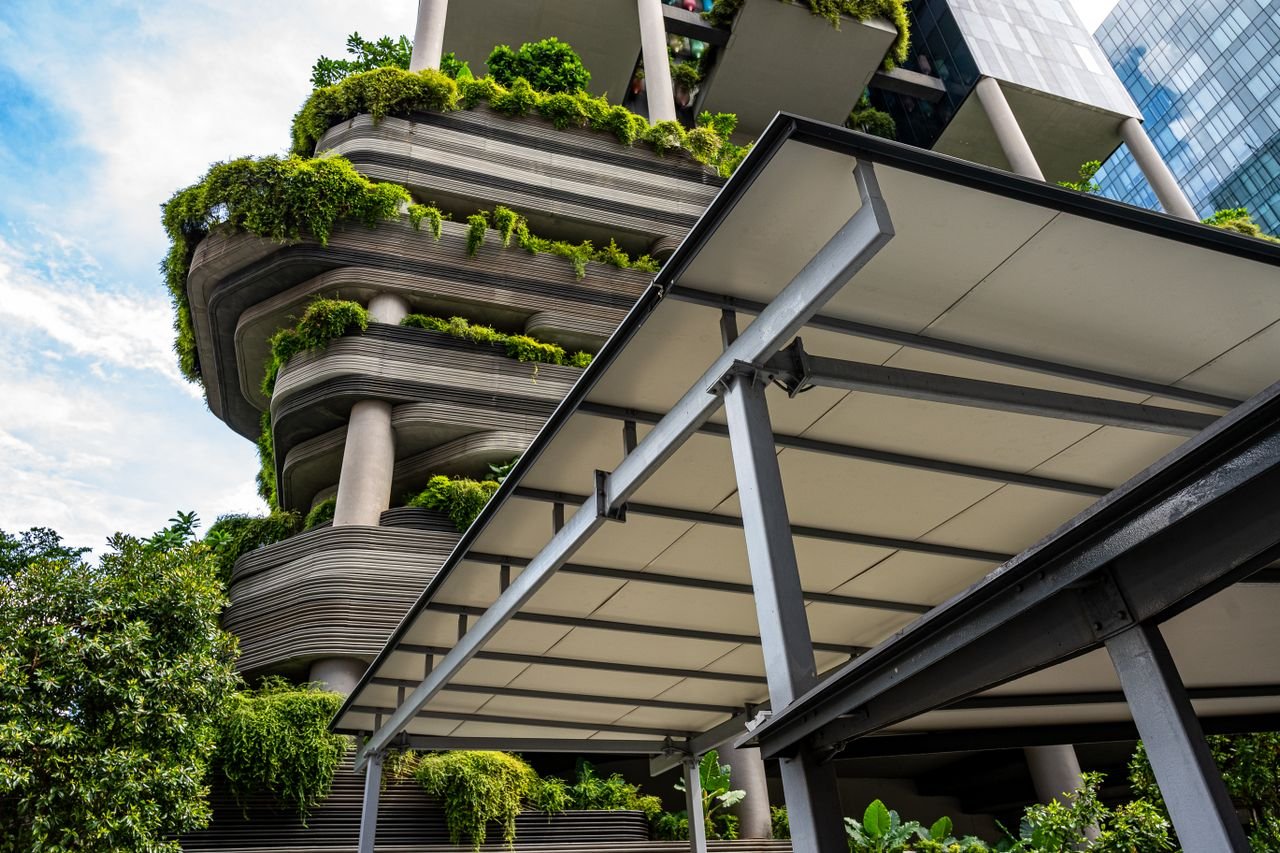
The climate revolution may not begin with futuristic cities or extraordinary inventions. It might begin with the buildings we already call home.
Imagine a world where your home stays warm without wasting energy, your workplace generates less pollution, and your neighbourhood shares resources instead of consuming them independently. Where sustainability isn’t an expensive upgrade or a lifestyle reserved for the privileged, but an ordinary part of everyday life.
This future is not as distant as we might think.
For decades, conversations about climate change have focused on what individuals should stop doing: driving less, flying less, buying less, and consuming differently. While personal responsibility matters, an equally important question often goes unasked:
What if the environments we’ve built around ourselves are making sustainable living unnecessarily difficult?
The answer could transform how we approach climate action.
The Environmental Cost of Everyday Comfort

Buildings are more than physical structures. They are complex systems that consume energy, water, materials, and resources throughout their lives.
And their environmental footprint is enormous.
According to the United Nations Environment Programme’s 2025–2026 Global Status Report for Buildings and Construction, the building and construction sector accounts for approximately 37% of global emissions, 28% of energy consumption, and nearly half of global material extraction.
These figures reveal something remarkable: one of our greatest opportunities to address climate change exists in the spaces where we spend most of our lives.
Canada faces its own challenges. According to the federal government’s 2026 National Inventory Report, buildings produced approximately 81 million tonnes of greenhouse gas emissions in 2024, representing 12% of national emissions.
Behind these statistics are ordinary activities: heating an apartment, cooling an office, providing hot water, and maintaining comfortable indoor environments.
The problem isn’t that people want comfort.
It’s that too many of our buildings require excessive resources to provide it.
The Greenest Building Might Be the One We Already Have
When we imagine sustainable architecture, we often picture beautiful new structures covered in solar panels, vertical gardens, and innovative materials.
But sustainability isn’t always about building something new.
Sometimes, it means improving what already exists.
Every building contains embedded resources: concrete, steel, timber, glass, transportation, labour, and the energy used to manufacture its materials. Demolishing a functional structure and constructing another can create substantial additional environmental impacts.
This is where building retrofits become particularly important.
Improving insulation, sealing uncontrolled air leaks, upgrading windows, optimizing ventilation, and replacing inefficient heating systems can reduce the resources required to operate existing buildings.
The International Energy Agency’s 2026 Special Report on Buildings Efficiency identifies better building envelopes, efficient equipment, and electrification as major opportunities for reducing global energy demand.
The underlying principle is surprisingly simple.
Before asking how to produce more energy, we should ask why we need so much of it in the first place.
A well-designed building doesn’t merely consume cleaner energy. It needs less energy to begin with.
That distinction is fundamental to genuine sustainability.
The Quiet Revolution in Heating and Cooling
Among the most promising technologies in sustainable buildings is one that rarely receives the attention given to electric vehicles or renewable energy installations: the heat pump.
Unlike conventional heating systems that generate heat through combustion or electrical resistance, heat pumps transfer thermal energy from one location to another.
This allows them to provide substantially more heating energy than the electricity they consume.
According to the International Energy Agency, heat pumps are typically three to five times more efficient than fossil-fuel boilers under the conditions considered in its global analysis.
Modern cold-climate systems have also expanded the potential for heat pumps in countries such as Canada.
But technology alone cannot solve the problem.
A highly efficient heating system installed in a poorly insulated building may still face unnecessary demand. Improper equipment sizing, inadequate maintenance, and poorly designed distribution systems can undermine expected savings.
Sustainable heating and cooling therefore requires a complete systems approach.
Buildings must be designed to retain comfort, equipment must operate efficiently, and the people maintaining these systems must understand how everything works together.
It is an important reminder that the green transition will depend not only on technological breakthroughs, but also on skilled technicians, designers, and tradespeople.
What If Neighbourhoods Shared Their Energy?
Our homes are often designed as independent consumers of energy. Each building has its own heating equipment, cooling systems, and energy demands.
But what happens when we think beyond individual buildings?
District energy systems offer an alternative.
Instead of every building independently producing all its heating or cooling, interconnected networks can distribute thermal energy across multiple structures.
These networks can potentially capture otherwise wasted heat from industrial processes, wastewater, or commercial operations and put it to productive use.
The International Energy Agency’s 2026 report on district energy estimates that district networks already provide heat to approximately 600 million people worldwide. It also highlights opportunities to integrate geothermal energy, recovered waste heat, large-scale heat pumps, and thermal storage.
Not every district system is sustainable; many still depend heavily on fossil fuels. Their environmental value depends on how the energy is produced and delivered.
Nevertheless, the broader idea is powerful.
Instead of treating each building as an isolated problem, we can begin designing communities as connected systems.
It’s a shift from individual efficiency toward collective intelligence.
Sustainability Must Also Be About Justice
There is another dimension to the built environment that deserves more attention.
Not everyone experiences climate change equally, and not everyone can afford the technologies designed to address it.
In Canada, maintaining a safe indoor temperature is already a financial struggle for many households.
Statistics Canada reported that in 2023, 14% of Canadian households had kept their homes at unsafe or uncomfortable temperatures for at least one month because heating or cooling was unaffordable.
This isn’t simply an energy-efficiency problem.
It’s a question of dignity, public health, and environmental justice.
As extreme weather becomes increasingly disruptive, access to reliable heating and cooling must be understood as more than a matter of convenience.
For example, Health Canada’s 2026 guidance recommends an upper indoor temperature limit of 26°C to protect older adults vulnerable to heat.
Yet renters, lower-income households, and residents of aging buildings may have limited control over improvements to their living environments.
A sustainable future cannot be defined only by how advanced our technologies become.
It must also be measured by who can access them.
Public investment, accessible financing, stronger building standards, and protections for vulnerable residents are therefore essential parts of climate action.
A building cannot truly be called sustainable if it protects the environment while failing the people inside it.
From Conscious Consumption to Conscious Design
Environmental responsibility is often presented as a series of consumer decisions: choosing reusable products, reducing packaging, or purchasing environmentally friendly alternatives.
These actions can be valuable.
But individual choices operate within systems we did not necessarily design.
A person cannot choose efficient public transportation where none exists. A renter cannot independently retrofit an entire apartment building. And a household cannot control the carbon intensity of every material used to construct its home.
That is why sustainability must move beyond consumption and become embedded in design, infrastructure, education, and public policy.
We need buildings that are easier to maintain, equipment designed for repair rather than premature replacement, materials that can be recovered and reused, and communities where resources circulate instead of being discarded.
We also need to recognize the people making these transformations possible: engineers, technicians, architects, construction workers, researchers, policymakers, and everyday citizens.
Their work may not always look revolutionary.
Sometimes it looks like repairing ductwork, improving insulation, balancing an airflow system, or making an old building perform better.
But meaningful change often begins with work that goes unnoticed.
The Future Isn’t Something We Simply Wait For
Perhaps the most important shift in sustainability is not technological, but philosophical.
We have grown accustomed to measuring progress by how much more we can produce, construct, and consume.
What if progress meant achieving better outcomes with fewer resources?
What if innovation meant extending the life of something instead of replacing it?
What if a successful city wasn’t simply smarter or larger, but healthier, more resilient, and more accessible to everyone?
The solutions will not emerge from one invention, one industry, or one generation.
They will come from connecting disciplines, questioning conventional practices, and recognizing that environmental responsibility is inseparable from human well-being.
At Syncing Karma, we believe the future of sustainability belongs to ideas that connect meaningful action with measurable impact.
Because building a better future doesn’t always mean starting from nothing.
Sometimes, it means looking at everything we’ve already created and asking a better question:
How can we make what we already have work better, last longer, and serve more people?
Same roots. New possibilities. Let’s make the things we do matter.
References and Further Reading
- United Nations Environment Programme. (2026). Global Status Report for Buildings and Construction 2025–2026: Key findings.
- Environment and Climate Change Canada. (2026). National Inventory Report: Greenhouse gas sources and sinks in Canada—Executive summary.
- International Energy Agency. (2026). Special Report on Buildings Efficiency.
- International Energy Agency. (2026). Renewables in District Energy.
- Statistics Canada. (2023). Canadian Social Survey: Energy use.
- Health Canada. (2026). Guidance on upper indoor temperature limits: Protecting the health of older adults.
